
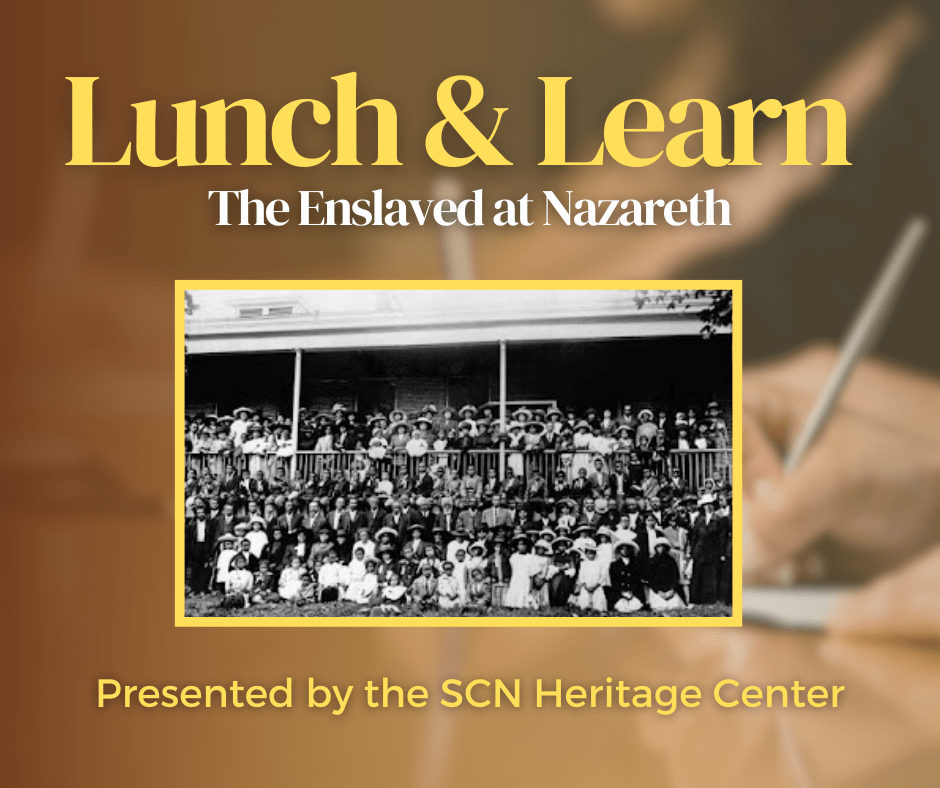

On Wednesday, Dec. 11, 2024, a Lunch & Learn event organized by the Heritage Center invited campus staff to delve into the lives and contributions of the enslaved people who were once a part of Nazareth’s history. Presented by Archivist Veronica Priest and Heritage Hall Coordinator Michael Smith, the discussion reviewed archival records, letters, and accounts that revealed a complex yet important chapter of the Congregation’s past. The presentation can be viewed below:
A History Rooted in Early Kentucky
As settlers arrived from Maryland and Virginia in the early 19th century, enslaved individuals were brought to Kentucky to assist in building and maintaining farms, including Nazareth’s growing community. The Sisters, who operated a boarding school and farm, relied on their labor for crops, construction, and day-to-day tasks. Historical census records show the number of enslaved individuals at Nazareth increased from 13 in 1830 to 27 by 1840.
Documents such as manumission letters and bills of sale, preserved in the Nazareth archives, provide further insight. These records note that while the Catholic Church encouraged humane treatment and sacramental marriage of enslaved persons, the institution of slavery persisted until the Civil War and the 13th Amendment in 1865.
Daily Life and Faith
Life at Nazareth was marked by hardship, yet faith remained central. The enslaved worked alongside the Sisters in kitchens, laundries, and on the farm. Sacraments such as baptism and marriage were celebrated, often with communal gatherings and simple feasts. Letters reflect glimpses of personal lives, with references to individuals like Ellen, who cared for the Sisters’ laundry, or Rachel, who cooked for the household.
Despite challenging conditions, spiritual care was a priority. The Catholic community believed in the salvation of souls, offering catechesis, baptisms, and spiritual retreats for the enslaved, integrating them into the faith life at Nazareth.
Freedom and Legacy
When freedom came, Nazareth’s records capture the mixed emotions of those emancipated. Many remained nearby, working as free laborers for years. Some families continued their connection with Nazareth well into the 20th century, including Monroe Smith, a man born into slavery who worked at Nazareth for over 30 years until his death in 1947.
In recent years, the Sisters have sought reconciliation. A formal apology was expressed during a 2000 service alongside other religious communities, acknowledging the regrettable past. In 2012, a monument was dedicated to honor the men, women, and children who were enslaved at Nazareth, ensuring their names and stories would not be forgotten.
What matters is reconciliation with our past deeds. The enslaved I am sure have forgiven us, let us thank them for building a heavenly Motherhouse, environment and all!